64 Kilobytes of Ice: The Coders Who Squeezed a Whole Sport Onto a Cartridge
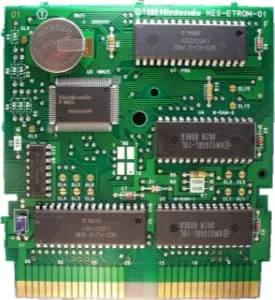
Photo: vintage NES cartridge circuit board close up retro game development, via retrogamestart.com
Modern hockey games ship on discs and downloads measured in tens of gigabytes. The classics we celebrate here were built on cartridges measured in kilobytes. Sixty-four of them, sometimes fewer. That's less memory than a single photo on your phone — and somehow, these teams delivered line changes, breakaway AI, and ice that felt like ice.
We dug through interviews, GDC retrospectives, and archived developer commentary to piece together how they did it — and what they'd have done with one more kilobyte.
The Math That Didn't Work
The first thing every 8-bit hockey programmer learned: you cannot simulate hockey. You have to fake it convincingly.
A real NHL game has 60 minutes of play, fluid substitutions, and 12 players on the ice with independent decisions. An NES cartridge had, at best, a few kilobytes of program space and a processor slower than the key fob in your pocket. So developers cheated — constantly, and brilliantly.
Archived interviews with Konami's Blades of Steel team reveal the now-famous approach: the fights, the crowd noise, the zoomed-in brawl mini-game weren't creative flourishes. They were resource management. A dedicated fight screen was cheaper to render than another minute of full-ice simulation. The most beloved feature in retro hockey history was, in a sense, a cost-cutting measure.
Fake AI, Real Instincts
The breakaway AI in games like NHL '94 remains a source of genuine engineering pride. With no room for true pathfinding, programmers built what veterans described as "state machines with attitude" — a handful of behavior modes (chase, defend, breakaway, dump) that swapped based on puck position.
The result fooled everyone. Players swore the computer was reading their tendencies and adapting. It wasn't. It was a lookup table. But the illusion of a thinking opponent — built from what one EA developer reportedly called "a few dozen if-statements and a lot of playtesting" — is why retro hockey still feels alive today.
Ice physics posed the same problem. Real friction simulation was impossible, so coders tuned glide constants by feel until the puck skittered just right. One programmer's note, repeated across several interviews of the era: the puck's movement was adjusted "until it felt like a puck," which was the entire physics documentation.
The Trade-Offs That Stung
Ask any of these developers what got cut, and the answers come fast:
- Line changes. Most 8-bit titles had fixed lines because substitution logic cost memory they didn't have. Players rotated by period, not by fatigue.
- Rosters. The NHLPA licensing battles of the early '90s meant some teams shipped with numbers instead of names — not for legal reasons alone, but because every name string ate precious bytes.
- Sound. Full commentary was a fantasy. A few synthesized crowd loops and a horn had to carry the atmosphere of an entire arena.
- Season modes. The idea of an 82-game season on a cartridge was a punchline. You got one game, or maybe a best-of-seven, and you liked it.
And yet the constraint bred clarity. Without room for bloat, every mechanic that made the cut had to earn its bytes. That's why pick-up-and-play still works in these games — there was literally nothing else on the cartridge.
What They Wish They'd Built
The regret lists are touching. Season modes top nearly everyone's. Real player names. A save battery so a season could survive a power cycle. One programmer from a smaller studio lamented never getting weather effects — outdoor pond hockey on a 16-bit cartridge, a dream that wouldn't ship properly for another two decades.
And more than one developer admitted the same quiet wish: enough memory to make the fights optional. Because the brawls were beloved, but they were also a compromise — a dazzling one, born from a machine that couldn't afford the real game.
Why It Still Matters
Every modern sim that tracks player fatigue, simulates board physics, or renders 20,000 individual fans stands on the work of those coders. They proved a sport could live in silicon smaller than a postage stamp, and their solutions — state machines, lookup tables, tuned constants — became the foundations of the genre.
So the next time you fire up an old cabinet or blow the dust out of a cartridge, remember: you're not just playing a game. You're playing six figures of ingenuity, compressed into 64 kilobytes, and it still runs like a dream.
Got a favorite piece of retro hockey engineering? Tell us in the comments — the programmers are still out there, and they love hearing their tricks worked.