Enemy at the Blue Line: How Cold War Anxiety Became Arcade Hockey's Best Two-Player Mode
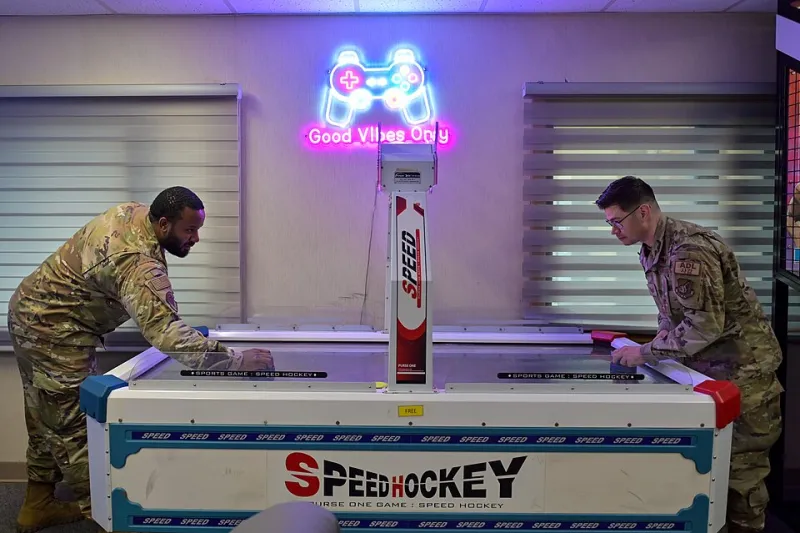
Photo: U.S. Air Force photo by Tech. Sgt. Stephanie Serrano, Public domain, via Wikimedia Commons
There is a particular kind of silence that falls over an arcade when two players pick USA and USSR in an old hockey game. The cabinet does not know geopolitics. The puck does not care about diplomacy. But the people standing at the controls do. Suddenly a simple game of pass-shoot-score becomes something bigger: a best-of-three referendum on national character, decided by pixelated slap shots and a goalie who moves like he is skating through wet cement.
That is the strange magic of Cold War-era arcade hockey. The games were never history lessons. They were quarter-fed sports sims with chunky sprites and crowd noise that sounded like a cassette tape being eaten alive. Yet the design choices, the team select screens, the cabinet art, and the trash talk all borrowed from the same cultural weather system: USA versus USSR, red versus blue, us versus them. Nobody needed a briefing packet. The rivalry was already in the air.
The Roster Was the Message
Early hockey video games did not have the luxury of deep commentary or licensed leagues. They had a handful of teams and a dream. So designers reached for the most recognizable international matchup they could find. The USA-USSR pairing showed up in all sorts of places, from home-console cartridges to arcade boards, and it carried instant meaning. You did not have to explain why the red team felt like the final boss. You just picked your side and leaned in.
In the 1980s, that pairing was not abstract. The Cold War was on the evening news, in the movies, and in the schoolyard arguments about who had the better everything. The Miracle on Ice in 1980 gave American sports fans a permanent reference point, and arcade hockey happily traded on that afterglow. A game could put USA and USSR on the team select screen and let the player's imagination do the rest. The roster was the message. The message was: this one counts.
What is interesting is how little the games had to do to sell it. There were no cutscenes about arms treaties. No pre-game monologue about ideological struggle. Just a flag, a color scheme, and the knowledge that the kid next to you was going to talk trash if you lost. Arcade hockey understood that the best rivalries are not explained. They are felt.
Cabinet Art and the Language of Rivalry
Period ads and cabinet art often leaned into the same red-white-and-blue framing. You would see bold lettering, aggressive angles, and goalies who looked like they had been carved out of a lunch tray. The message was not subtle: this is fast, this is physical, and somebody is going to get embarrassed. When a game wanted to raise the stakes, it did not need a licensed arena. It needed a color palette and a country name.
That approach worked because arcade cabinets were public furniture. You did not play in a quiet living room. You played in a loud, sticky-carpeted room with other people watching. A USA-USSR matchup gave the crowd a side to pick. It gave the loser an excuse. It gave the winner a story. The cabinet art was the billboard. The game screen was the argument.
Some games played it straight. Others turned the rivalry into a kind of cartoon. Either way, the Cold War framing gave arcade hockey a shortcut to drama. It was cheaper than a licensed NHL roster and more immediate than a generic exhibition mode. A country name on a jersey did the work of a whole pre-game show.
Why It Still Stings in Two-Player
Play one of these old hockey games alone and the Cold War stuff feels like a curiosity. Play it against a friend and it comes roaring back. The rivalry is not really about the USSR or the USA anymore. It is about the person holding the other joystick. The country select screen just gives you permission to care too much.
That is why these matches still work in 2026. Retro hockey is at its best when it is simple enough to learn and mean enough to argue about. The old games had a way of making every goal feel like a diplomatic incident. A late slapshot from the blue line was not just a bad decision. It was an insult. A goalie save was not just a save. It was a border guard doing his job.
And the trash talk wrote itself. You did not need a headset. You needed eye contact and a quarter. The USA-USSR setup gave players a ready-made script: red scare, red line, red team, red face. It was silly, but it was also effective. Arcade games have always been machines for turning simple actions into big feelings. Cold War hockey just found a shortcut.
A Quarter-Bought History Lesson
Looking back, the geopolitics were never the point. The point was the grudge match. But that does not mean the setting was meaningless. These games captured a moment when the world felt split into two teams, and they translated that feeling into a form a kid could understand: pick a side, defend the net, blame the joystick.
In 2026, the Cold War is history, but the arcade hockey version of it still has juice. It lives in the team select screen, in the cabinet art, in the way an old CRT makes red jerseys glow like a warning light. It is a reminder that sports games have always been political whether they admit it or not. Sometimes the politics is a treaty. Sometimes it is a two-player grudge match and a goalie who cannot stop a weak wrister from the slot.
Either way, you put in your quarter, pick your country, and hope the other guy does not score first. The Cold War may be over. The rivalry is not.